Why is the Mona Lisa painting famous?
The Mona Lisa is considered the most famous painting in the world, and the answer to why is not one thing but many things stacked on top of each other. Leonardo da Vinci created a small, quiet portrait of a Florentine woman around 1503, and over five centuries it gathered layers of story, scandal and reproduction until it became less a painting and more a symbol. It is recognized as an important symbol of Renaissance artistic achievement, but its fame also runs on theft, newspaper headlines, songs, memes and popular culture in ways Leonardo could never have predicted.
I write this as a tram driver in Adelaide who spends his rest days in the Art Gallery of South Australia with a pocket notebook. I have never stood in front of the real Mona Lisa. I know it through prints, screens and the copy sketches I make to understand what I am looking at. That honesty feels important here, because the painting’s fame is partly about the gap between what we imagine and what is actually there: a panel of poplar wood, roughly 77 by 53 centimetres, behind bulletproof glass in Paris.
Here is what built that fame, in short:
-
Leonardo’s technical genius, especially the sfumato technique that makes her face seem alive.
-
The 1911 theft that turned a respected masterpiece into front page news across the world.
-
Centuries of royal collecting, writing, printing and reproduction.
-
Endless parodies, from Marcel Duchamp’s moustache to T-shirt designs, that kept the image circulating far beyond the art world.
This article moves from who painted it and who “Mona Lisa” actually is, through the theft that changed everything, to how it ended up on your coffee mug.
Who is Mona Lisa? Lisa del Giocondo and the title “La Gioconda”
The person depicted in the painting is generally identified as Lisa Gherardini, born in Florence in 1479 and married in 1495 to Francesco del Giocondo, a wealthy Florentine silk merchant. She is referred to in historic sources as Lisa del Giocondo. The sitter is believed to be Lisa del Giocondo based on two key pieces of evidence that art historians keep returning to.
The first is a handwritten note by Agostino Vespucci, dated October 1503, scribbled in the margin of a printed edition of Cicero. Vespucci mentions that Leonardo is working on the portrait of Lisa del Giocondo. The second is Giorgio Vasari’s account in his 1550 book Lives of the Painters, where he identifies the sitter as Lisa, wife of Francesco, and describes the portrait in admiring detail. Giorgio Vasari first identified the sitter in 1550, and his words shaped how later generations understood the painting.
The title “Mona Lisa” comes from Monna Lisa, which simply means “Madam Lisa” in Italian. In Italy the painting is called La Gioconda, the feminine form of her married name, and in France it goes by La Joconde. The name Gioconda carries a second meaning: “the joyful one” or “the playful one,” which adds a layer of wordplay to the mystery of her expression.
Alternative theories suggest other identities for the sitter. Some scholars have proposed Isabella d’Este, the cultured Marchioness of Mantua. Others have named Isabella Gualanda or a mistress connected to Giuliano de Medici. A few have even suggested that the person depicted might be an idealised figure rather than a real woman. But the Vespucci note plus Vasari’s record remain the strongest evidence, and the lingering doubt is itself part of the fascination. We know a great deal, and we still wonder.
Leonardo da Vinci and the making of the Mona Lisa
Leonardo da Vinci was a painter, anatomist, engineer and restless thinker, often described as a genius of the Renaissance. He finished remarkably few paintings in his life, fewer than twenty, so every surviving work carries weight. Each one represents years of thought, observation and revision rather than quick production.
Leonardo began painting the Mona Lisa around 1503 in Florence. Most scholars date the core work to between 1503 and 1506, but there is strong evidence he kept refining it for years afterward, adding translucent glazes and adjusting tones. Leonardo da Vinci painted the Mona Lisa around 1503 to 1519, and he carried the painting for 14 years before his death, never handing it over to the Giocondo family. He simply kept it with him, fiddling, adjusting, reconsidering.
I find that detail telling. When I started visiting galleries five years ago I assumed famous paintings were famous because of some obvious flash, something large or dramatic or covered in gold. The Mona Lisa’s quiet colour and small size taught me otherwise. This Italian artist did not hand over his work and move on. He cared enough to carry it across Italy and eventually to France.
The painting is oil on a thin poplar wood panel, about 77 by 53 centimetres. There is a so-called Isleworth Mona Lisa, an earlier version some contend was by Leonardo showing Lisa at a younger age, but the Louvre’s painting is the one history made famous. That is the panel people queue for.
What you actually see: composition, pose and background
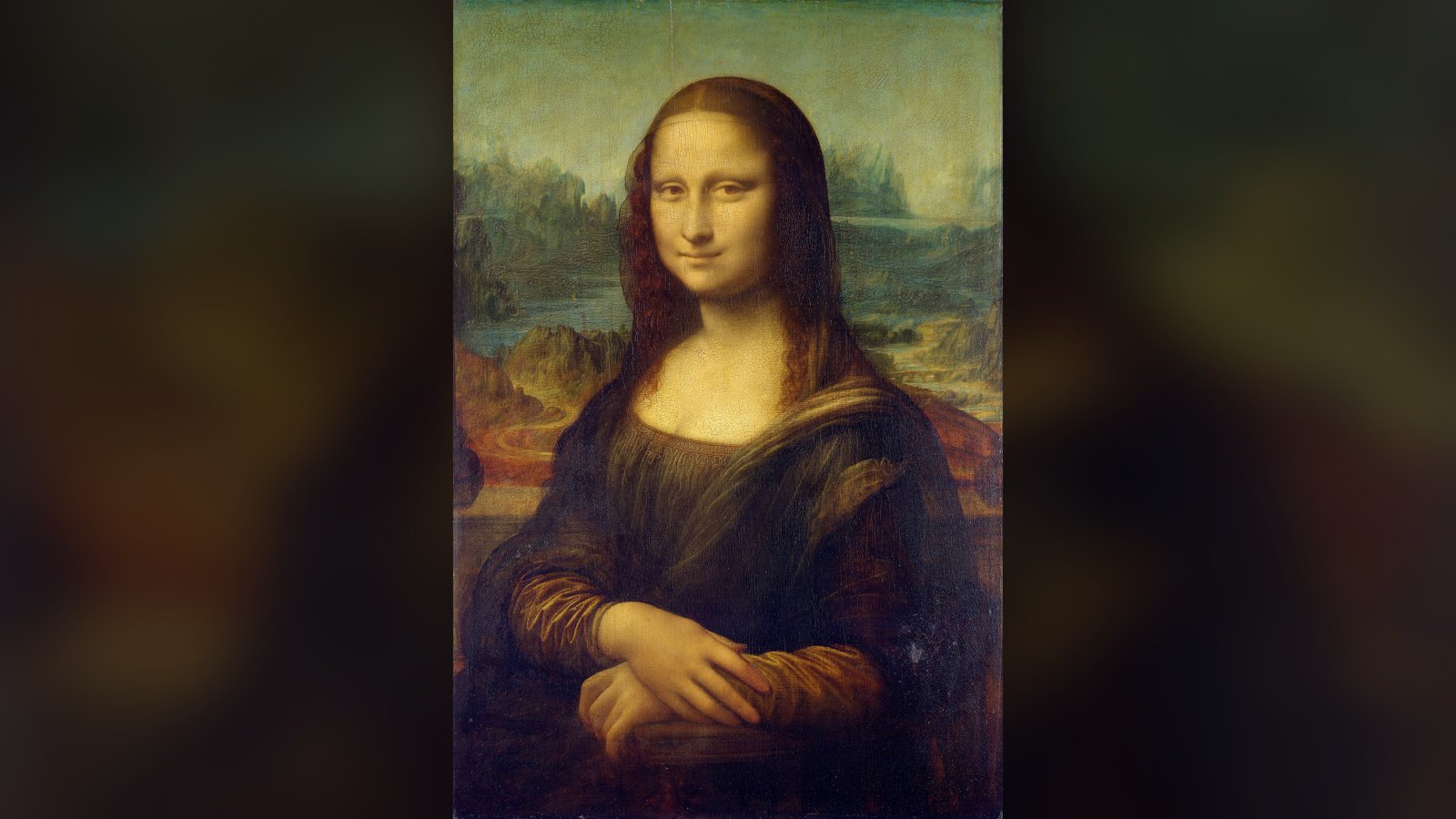
Picture a dark-haired woman seated at a slight angle, her body turning gently toward you. Her hands are folded, resting on the arm of a chair. Behind her stretches a strange, misty landscape of winding roads, a distant bridge and bluish mountains that seem to belong to a dream rather than a real place.
Around 1500, Italian portraits often showed subjects in stiff profile or against flat, dark backdrops. Leonardo’s choice of a three-quarter view, where both eyes and both hands are visible, was still fairly new. It made her feel alive and approachable in a way that many earlier portraits did not. Raphael visited Leonardo’s workshop and came away influenced by exactly this kind of composition.
Leonardo used aerial perspective to create depth in the background. Colours fade and lose contrast as they recede, and the distant mountains dissolve into a haze of blue. The horizons on either side of her head sit at slightly different heights, which gives the landscape an off-balance, dreamlike tension behind her calm pose.
One detail that surprises many people: the painting features no clearly visible eyebrows or eyelashes. Whether they were originally painted lightly and lost through centuries of cleaning, or never strongly rendered in the first place, remains debated. Recent multispectral imaging suggests they are practically absent. It adds to the modern sense of strangeness when you look closely at a print.
Leonardo’s techniques: sfumato, light and the “living” face
Technical brilliance is one of the core reasons the Mona Lisa painting has been admired for centuries, not just by the general public but by every painter and art critic who has studied it closely.
The key word is sfumato, from the Italian sfumare, meaning “to smoke out” or “to blend.” The sfumato technique produces soft transitions between colors and tones, with no hard edges. Around her mouth, under her eyes, across her cheeks, the boundaries between light and shadow are gradual and uncertain. Leonardo built these effects with many thin, translucent glazes layered over time, which is part of why the painting took so many years.
When I make a copy sketch of a portrait I always start with outlines. With the Mona Lisa that plan falls apart, because Leonardo painted without outlines to enhance realism. There are almost no hard edges to trace. The form is built entirely through shading and tonal shifts. This is how sfumato became real for me: not as a vocabulary word but as a problem I could not solve with my pencil.
Leonardo’s study of anatomy, including his famous dissections, informed how he modelled flesh and bone. Mona Lisa’s smile is a result of Leonardo’s anatomical studies, his understanding of how muscles around the mouth create subtle expressions. The face and hands seem lit from within, glowing against the darker clothing and background, which is why viewers often call her “alive” rather than painted.
The smile, the gaze and the so-called “Mona Lisa illusion”
Most visitors arrive expecting “the mysterious Mona Lisa smile,” and that expectation is itself part of the fame. We have been told for generations that something strange happens with her mouth, so we look for it, and then we find it, or think we do.
The Mona Lisa’s smile appears to change depending on the viewer’s perspective. The slightly asymmetrical corners of her mouth, combined with sfumato shadows on the cheeks and around the lips, mean our brains read her mood differently from moment to moment. Look at the whole face from a distance and she seems to be smiling. Stare directly at her lips and the smile fades into something more neutral. It is not a trick so much as a result of how Leonardo handled uncertainty in edges.
Then there is the gaze. Leonardo positioned her eyes looking almost directly out, and because of slight asymmetries in lighting and pupil direction, her eyes seem to follow you around the room. Leonardo called this kind of study the “motions of the mind,” his phrase for how inner life shows through outward expression.
When I stare at her eyes in a print, the smile seems to fade. When I look at the background, it seems to appear. I am clear that this is not science, just what my own eyes told me over a couple of sketching sessions. But it is enough to understand why people have spent centuries writing comments about what she is thinking.
From Florence to France: how Leonardo brought the painting to the French court
In 1516, Leonardo accepted an invitation from King Francis I of France and travelled north, likely carrying the Mona Lisa with him. Leonardo brought the painting to the French court along with a small number of other works he had kept by his side for years.
He spent his final years at Clos Lucé, a manor house near the royal château of Amboise in the Loire Valley. Leonardo died there in May 1519. After his death, the portrait entered the French royal collections. Leonardo carried the painting for 14 years before his death, which tells you how personally he valued it. Over the following decades it hung at Fontainebleau and later at Versailles under Louis XIV.
By the 17th century, Leonardo’s portrait was already valued as a masterpiece in French court circles, long before mass tourism, newspapers or the internet existed. It was admired, but it was not yet the global celebrity it would become.
Revolution, wars and the Louvre: the painting’s adventurous display history
Part of the Mona Lisa’s later fame comes from surviving turbulent French history and being repeatedly moved, hidden and re-hung. Each move added to its story.
-
After the French Revolution, royal collections were nationalised. The painting was first exhibited in the Louvre in 1804, turning a royal treasure into a public museum piece that any person could see.
-
The Mona Lisa was praised as a masterpiece in the 1860s by critics and writers who began describing it in emotional, almost mystical terms. This literary attention helped build its reputation before the theft made it world-famous.
-
During the Second World War, the painting was evacuated from Paris and moved to country châteaux across France to protect it from bombing and looting.
-
Since 2005, it has been displayed behind bulletproof, climate-controlled glass in the Salle des États in the Louvre’s Denon Wing, with recent plans for a dedicated room to manage the enormous crowds.
I think being held by a major public museum matters more than people realise. A painting that stays accessible and well documented gets looked at, written about and put in books, and that builds a reputation decade after decade. If the Mona Lisa had stayed in a private collection, locked away, the story would be very different. The Wikipedia article on the Mona Lisa gives a thorough, source-backed overview of this display history for anyone who wants the full timeline.
The 1911 theft: how a crime made the Mona Lisa a global celebrity
On 21 August 1911, the Mona Lisa was stolen from the Louvre, and that single act changed its reputation forever. The painting was reported missing the day after the theft, when a painter who had come to sketch it noticed the empty wall. The Wikipedia page on the theft of the Mona Lisa lays out the sequence of events in more detail.
Vincenzo Peruggia was an Italian handyman and glazier who had worked at the Louvre. He believed the painting belonged in Italy and should be returned there. He hid inside the museum overnight, lifted Leonardo’s portrait from the wall, removed the panel from its protective frame and walked out with it hidden under his work coat. The Louvre closed for a week. The theft generated worldwide media attention for the painting. Newspapers across Europe and America printed photographs of the empty wall. The story made the front page everywhere. Even Pablo Picasso and the poet Guillaume Apollinaire were questioned by Paris police before being cleared.
Peruggia kept the painting for about two years in his small apartment in Paris. In December 1913 he attempted to sell it to the Uffizi Gallery in Florence, where museum director Giovanni Poggi recognised it and contacted the authorities. The painting was recovered, then toured briefly through Florence, Milan and Rome. Over 100,000 people viewed the painting in two days after its return to display. The theft transformed the Mona Lisa into a cultural sensation.
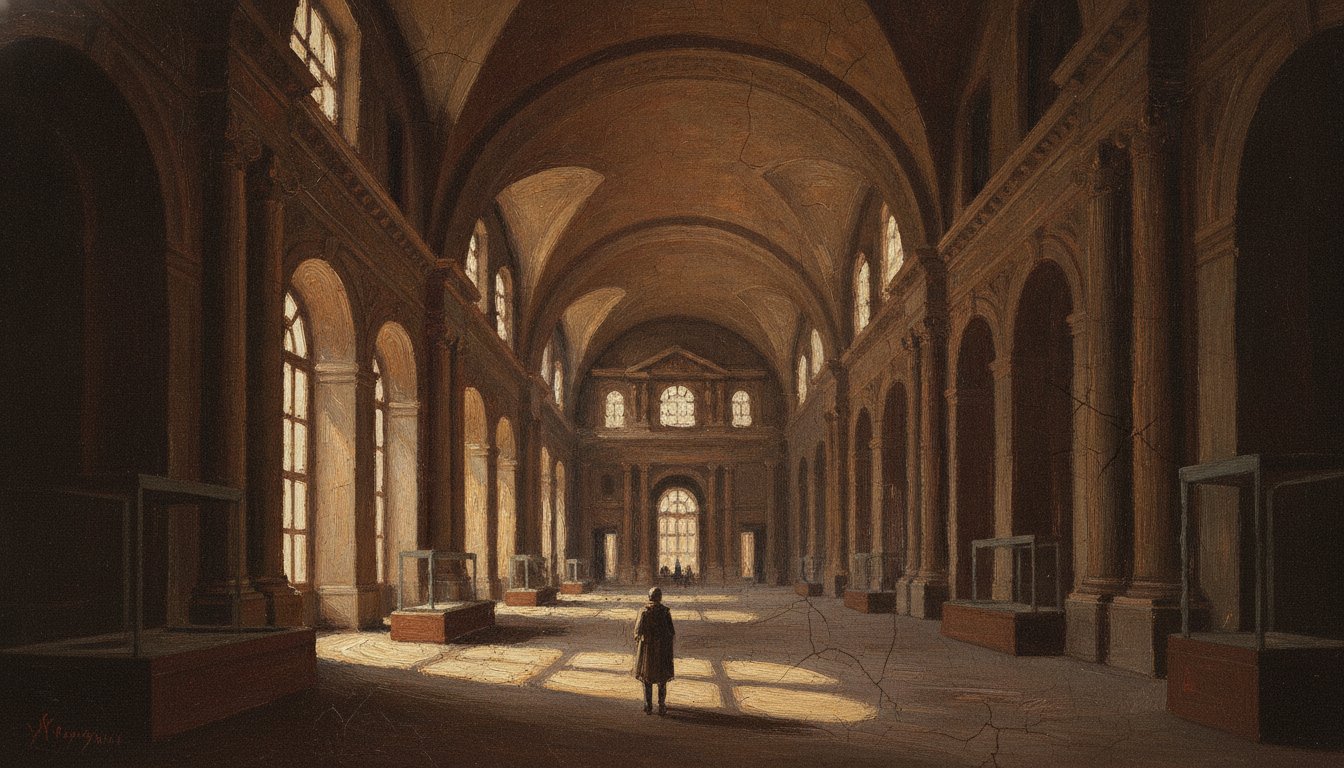
I think the theft is the part most people point to when they ask why this famous portrait matters, and they are right. A respected painting became a mystery, then a headline, then a triumph. People who had never visited a museum suddenly knew exactly what this picture looked like.
Vandalism, protection and the aura of untouchability
Fame attracts trouble, and the Mona Lisa has been targeted several times. In 1956 someone threw a rock at it, chipping a small area near the elbow. In 1974 red paint was sprayed at it during a display in Tokyo. In 2009 a visitor threw a ceramic teacup at the protective glass. More recently, protesters have smeared cake and soup on the glass as political stunts.
None of these attacks destroyed the painting, thanks to increasingly strong glazing. But the sealed case, the guards, the cameras and the barriers all add to its mystique. It sits behind thick glass like something both fragile and impossibly well defended, and that aura of untouchability makes the experience of seeing it feel less like visiting a museum and more like approaching a relic.
From masterpiece to media star: Mona Lisa in popular culture
The Mona Lisa is now as much a media image as a painting. Her face appears on mugs, posters, album covers, advertisements and an endless scroll of memes. Marcel Duchamp’s 1919 interpretation of the Mona Lisa contributed to its pop culture status when he took a cheap postcard reproduction, drew a moustache and goatee on it, and titled it LHOOQ. Read quickly in French, those letters sound like “elle a chaud au cul,” a vulgar joke. Duchamp’s point was partly that the image had become so well known it could survive being mocked, and the joke only works if the audience already recognises the original.
Salvador Dalí painted his own face onto the Mona Lisa composition. Andy Warhol screen-printed her. Dan Brown made Leonardo’s portrait central to The Da Vinci Code, with the character Robert Langdon chasing clues through the Louvre. Nat King Cole recorded a song simply called “Mona Lisa” in 1950, which won an Academy Award and introduced her name to millions who had never set foot in a gallery.
The boom in mass printing in the 19th and 20th centuries multiplied the image globally. By the time television arrived, most people in Boston, Washington, New York or York already knew her face. She had toured the United States in 1963, visiting Washington and the Metropolitan Museum in New York, drawing enormous crowds. John F. Kennedy attended the Washington unveiling. The constant re-use of this image made it the default symbol of “a famous artwork,” and each new parody or reference kept her visible to the general public.
I read Duchamp’s joke as proof that the painting had already won. A painting that gets mocked on that scale has usually passed beyond criticism into something bigger.
Crowds, expectations and the modern museum experience
I have not been to the Louvre, so I will not pretend I have stood in the Salle des États. But from reports, photos and the comments of friends who have been, the scene is vivid enough: a dense crowd of visitors angling phones over each other’s heads toward a surprisingly small painting on a distant wall.
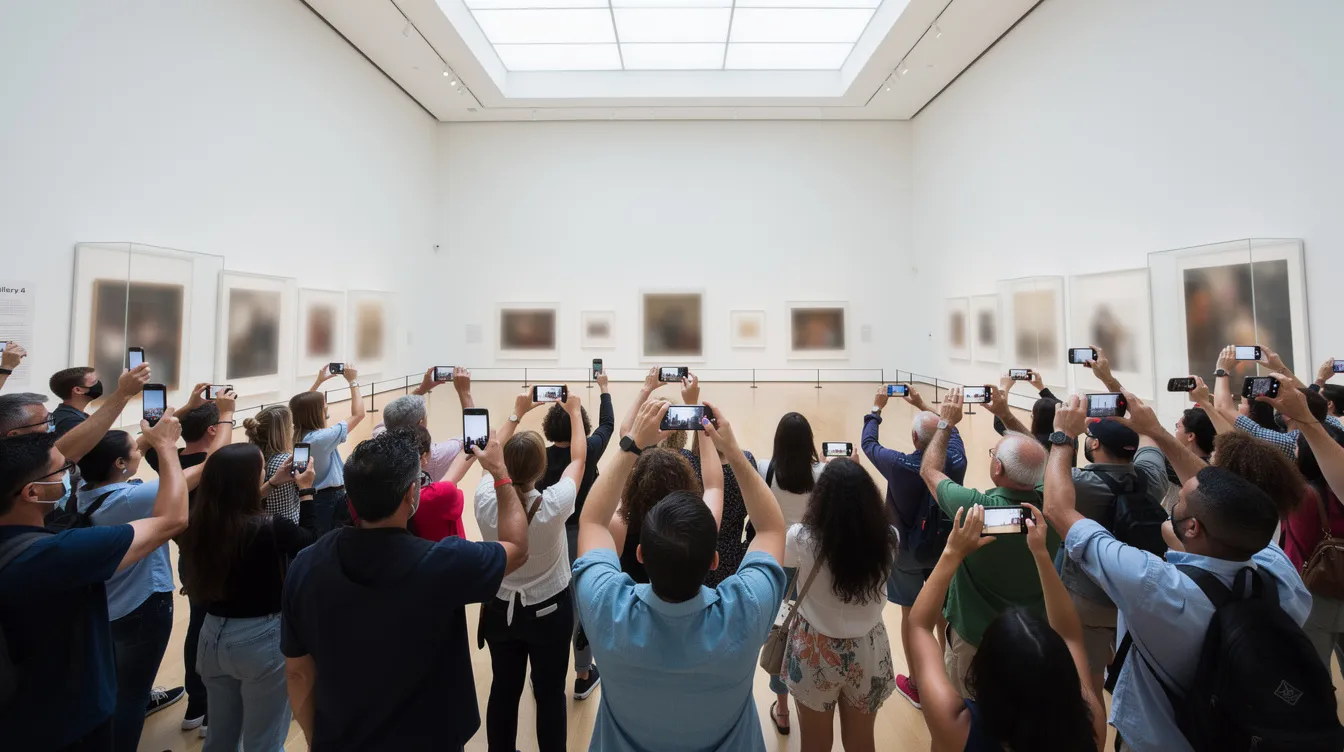
The numbers back this up. Over 10 million people view the painting annually at the Louvre, and surveys show 80 percent of Louvre visitors come to see the Mona Lisa. Many of them are first-time museum visitors. Some spend three or four minutes near the painting, but close, unobstructed viewing tends to last about 50 seconds. That is not much time for a masterpiece that took more than a decade to make.
The feedback loop is real: people visit because it is famous, and it stays famous because people visit and photograph themselves with it. Fame feeds on itself.
I contrast this with the quiet, slow looking I do in my local gallery in Adelaide. There are paintings there that repay a ten-minute look just as richly as anything behind glass in Paris, and nobody is elbowing me aside to take a selfie. The difference is not quality. It is fame, and fame is its own machine.
Artistic legacy: how the Mona Lisa influenced other painters
Painters respected the Mona Lisa long before it became a media icon. In the early 1500s, Raphael adopted the seated three-quarter pose with folded hands before a landscape in several of his own portraits, a format he appears to have picked up after visiting Leonardo’s workshop in Florence. Leonardo’s other known portraits, such as Ginevra de Benci, show elements of this approach, but the Mona Lisa brought everything together.
Workshop copies, including the version at the Prado in Madrid, helped spread Leonardo’s methods among students and apprentices. These copies taught young painters how glazing, sfumato and aerial perspective could be combined in a single portrait. If you want to see how other masters handled the same kind of portrait, browse these famous paintings by famous painters.
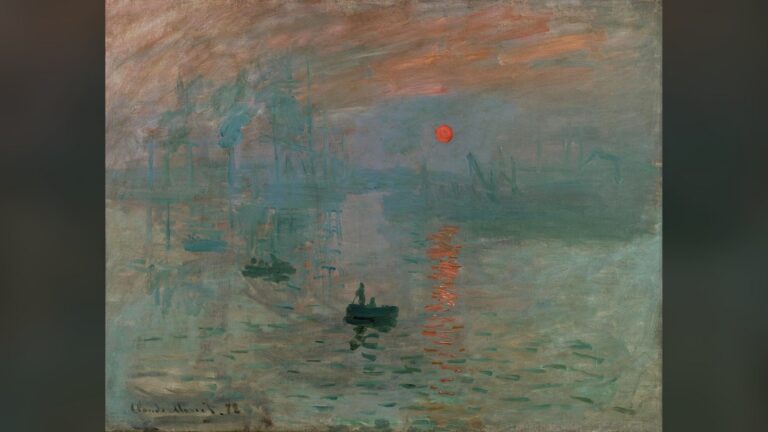
Later generations reacted differently. Romantic and Symbolist writers in the 19th century praised the painting’s mystery. Surrealists and Pop artists parodied it. A PBS documentary on Leonardo described the portrait as the work where da Vinci poured his lifetime of knowledge into a single image. Being endlessly quoted, copied and mocked is, in the history of art, a strong sign of deep and enduring influence. Every art historian who writes about Renaissance portraiture has to reckon with this painting. For a look at how a later painter pushed away from this smooth finish, read about the painting that named Impressionism.
My take as a casual gallery walker: what its fame tells us about art
The name “Mona Lisa” arrived in my life long before any real understanding. It came through a small picture in a schoolbook, a line in a pop song, a joke on television. By the time I started paying attention to paintings five years ago, I already “knew” the Mona Lisa without knowing anything about it. That is a strange kind of fame: the image precedes the experience for almost everyone.
When I look at the chain that built that fame, I see skill, timing, scandal and repetition all landing on the same small panel. Leonardo’s rare ability. Royal collecting in France. A public museum after a revolution. A theft in 1911 that inspired newspapers, songs and novels. Mass printing. Duchamp’s moustache. A world tour. Social media selfies. No single link in the chain would have been enough. Together, they turned a portrait of a merchant’s wife into the most reproduced image in art.
If you want to use the Mona Lisa as a training ground rather than just a sightseeing checkbox, here is the simple method I use with a print or screen:
-
Cover the face and look only at the hands and landscape for a full minute.
-
Find the softest edge you can see and try to point to exactly where cheek stops and shadow starts.
-
Squint until the figure becomes a gentle pyramid of light against dark.
-
Do a ten-minute sketch that skips the outline entirely and shades shapes instead.
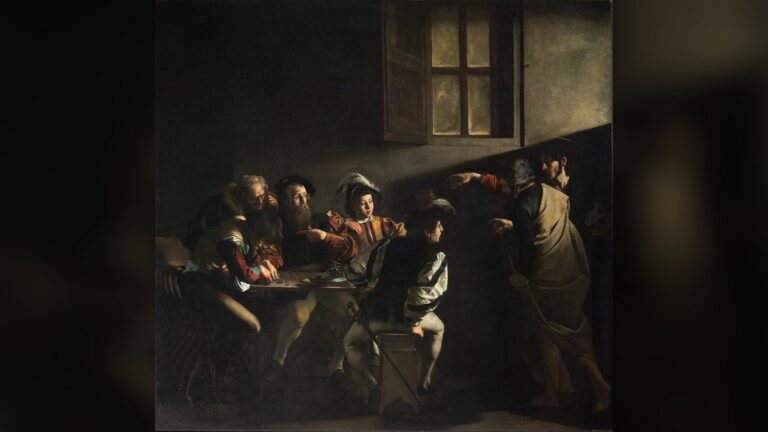
Compare this with Caravaggio’s Calling of St Matthew, a dramatic canvas that uses spotlights, bold gestures and large scale. Where the Mona Lisa whispers, Caravaggio shouts. Training your eye on both teaches you two completely different ways a painting can hold a room. I wrote a separate piece on The Calling of St Matthew if you want to look at it more closely.
I do not claim the Mona Lisa is the best painting ever made, and you do not need to either. Understanding the story, the technique and the accidents of history makes it easier to appreciate the painting for what it is rather than feeling let down that it is smaller than the legend. If you have a second son or a second thought about it, that is fine too. The painting has survived five centuries of opinions. It can handle yours.
FAQ
Why is the Mona Lisa so famous?
Mostly Leonardo’s reputation as a painter and genius, the soft lifelike style he created using sfumato, its place in the Louvre museum in Paris, and the 1911 theft that was stolen and made front page news around the world. Constant copying and parody in popular culture kept it visible to generations who never visited a gallery.
Who is the woman in the Mona Lisa?
She is generally identified as Lisa Gherardini, wife of the Florentine merchant Francesco del Giocondo, hence La Gioconda in Italian and La Joconde in French. The identification rests on a 1503 note by Agostino Vespucci and Giorgio Vasari’s 1550 account.
Why is her smile said to be mysterious?
Leonardo blurred the edges around the mouth and eyes with sfumato, so the expression seems to change as your eye moves. No hard line fixes the Mona Lisa smile in place, and the soft shadows make the brain read her mood differently depending on where you focus.
Is the Mona Lisa really small?
Yes. It measures roughly 77 by 53 centimetres, about the size of a large laptop screen. This surprises many visitors who expect something grander after seeing it enlarged in books and on screens.
Can I learn from the Mona Lisa as a beginner?
Yes. Try a short shading sketch with no outlines to train your eye to see soft transitions between light and dark. Focus on where one tone melts into another rather than trying to capture a sharp edge. It helps with any portrait, and it is the single exercise that taught me the most about how this painting works.