What is The Calling of St Matthew painting about?
Caravaggio’s calling of Saint Matthew is one of those paintings that grabs you before you understand it. A beam of light cuts through a dark room. A man at a table looks up from his coins. Jesus Christ stands at the door, pointing. That is the whole scene, and it changed art history.
Quick answer: what is “The Calling of Saint Matthew” about?
The Calling of Saint Matthew is an oil painting by Caravaggio, completed between 1599 and 1600 for the Contarelli Chapel in San Luigi dei Francesi, a church in Rome. It depicts the moment from the Gospel of Matthew 9:9 when Jesus sees the tax collector Levi, later known as Saint Matthew, sitting at his booth and says, “Follow me.” Levi gets up and follows. That single Bible verse is the entire story. If you want the painting’s basic details in one place, the Wikipedia article on the painting is a good start.
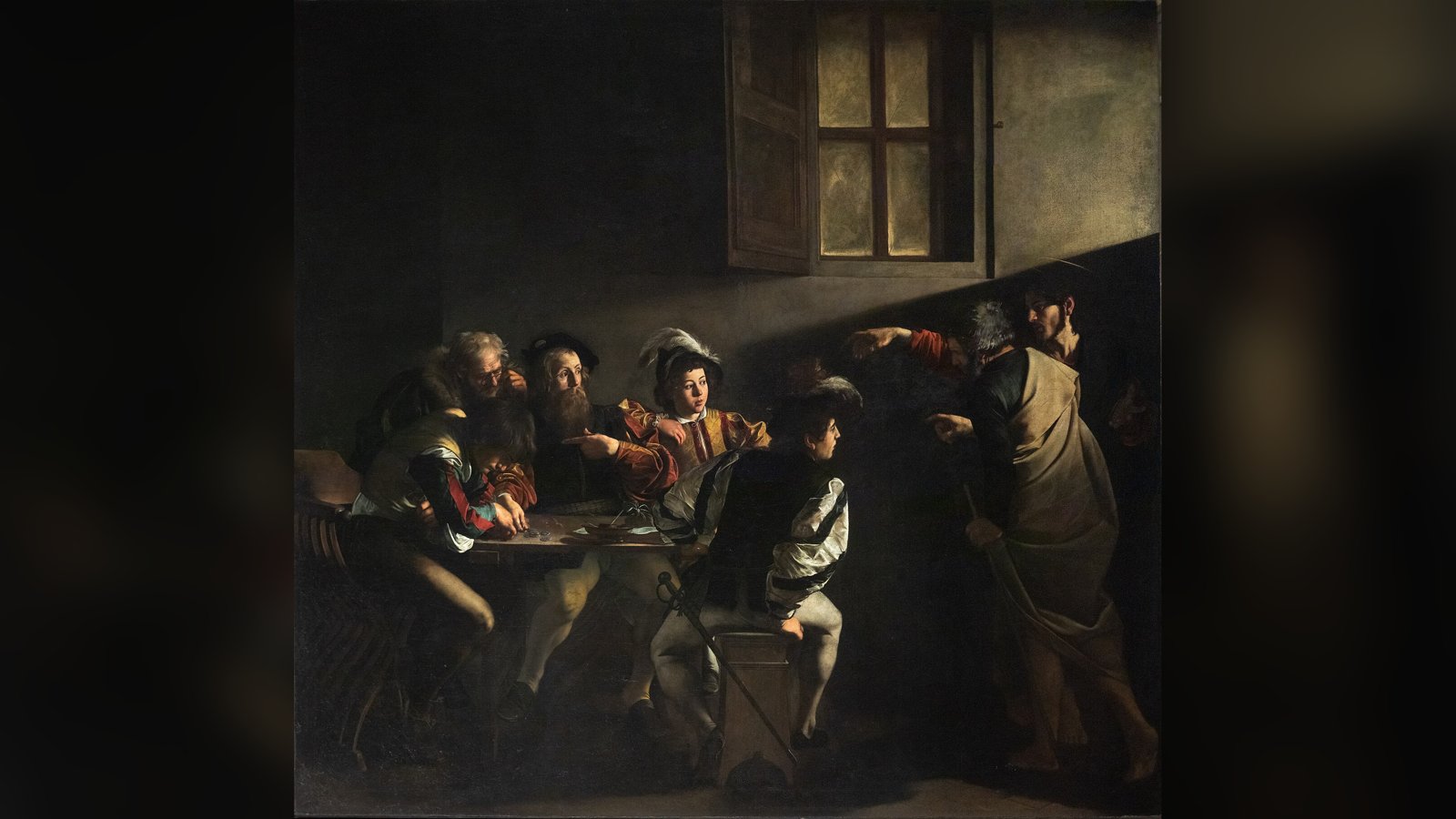
In the painting, Matthew sits at a table in a dark room counting money with four other figures. Christ enters from the right with Saint Peter just ahead of him, and a sharp beam of light descends from above Jesus’ head, cutting across the shadows to find Matthew’s face. Matthew looks up, startled, and points to himself as if to say: “Who, me?” His other hand still rests on the coins. The painting depicts a transition from darkness to light, from ordinary life to something else entirely.
I am Dev Chaudhry. I drive a tram in Adelaide, South Australia, and I spend my rest days in the Art Gallery of South Australia with a pocket notebook. I have never stood in front of this painting. I know it from books, screens and my own wobbly copy sketches, which is why I read it the way I read everything: shape by shape, light patch by dark patch, one question at a time. I have no credentials. But I think that is fine here, because the painting was made for ordinary people walking into a church, not for art historians walking into a lecture.
Where and when: placing Caravaggio’s Calling of Saint Matthew
The first thing I learned about this painting is that I cannot see it without leaving Australia. It still hangs where it was meant to hang: the Contarelli Chapel in San Luigi dei Francesi, near Piazza Navona in Rome. The chapel holds three paintings by Caravaggio about the life of Saint Matthew. The Calling sits on the left wall, The Martyrdom of Saint Matthew faces it on the right, and The Inspiration of Saint Matthew fills the altarpiece above. For the church’s own history, I found the Wikipedia page on San Luigi dei Francesi more useful than I expected.
The commission came from the estate of French Cardinal Matthieu Cointerel, whose Italianised name was Contarelli. He died in 1585 and left money for a chapel honoring his namesake saint. The project stalled for years until Caravaggio, then about twenty eight years old, was contracted on 23 July 1599. This was his first major church commission, the moment that turned him from a painter of small canvases and still lifes into a leading figure of the Baroque world.
From what I have read and watched, the chapel is dim. Visitors feed a euro into a coin operated spotlight, and the three paintings flare into brightness against the stone walls. Each canvas is enormous, roughly 322 by 340 centimetres. I imagine the darkness in that room makes Caravaggio’s shadows feel immersive in a way no photograph captures.
What the painting shows: identifying Saint Matthew and his companions
Here is the question that confused me the first time I looked at a reproduction: which guy at the table is Saint Matthew? There are five figures seated or standing around the table, and none of them wears a halo that jumps out at you. Christ does have a thin, almost invisible halo, a faint gold line, but the men at the table do not.
Most art historians identify Matthew as the bearded man near the center, the one pointing at his own chest in disbelief at Christ’s call. The same bearded figure appears in the other Contarelli Chapel paintings, which supports this reading. Around him are younger men dressed in fashionable sixteenth century clothes, slashed sleeves and feathered hats, bent over coins. An elderly man with spectacles is hunched over his money, oblivious to Christ’s presence. A young man, possibly a boy, leans forward, captivated by the coins rather than the figures at the door. The characters are preoccupied with money, and that contrast between spiritual values and material wealth is the painting’s quiet engine.
On the right, Christ enters the room with Peter, who stands slightly in front, as if the lord’s call passes through the apostle before it reaches Matthew. Christ’s feet are bare. Peter’s feet are bare. The tax men wear boots. That detail tells you who belongs to which world without a single word.
Some scholars argue Matthew is not the bearded man at all but the young man with his head bowed over the coins, and that the bearded man is pointing toward him, not at himself. I do not have the credentials to settle this, and honestly I do not need to. I like that a painting this famous still leaves room for argument. The absence of idealization in the figures portrays a realistic glimpse of human life intersecting with the divine, and that realism includes the fact that the moment is messy enough to read in more than one way.
Light, shadow, and gesture: how Caravaggio stages the calling
The scene feels like a stage set frozen at the exact second of decision. Nothing has happened yet, and everything is about to.
Caravaggio uses tenebrism to create dramatic contrasts of light and dark. Most of the room is swallowed in deep shadow. A sharp beam of light descends from above Jesus’ head, entering through a window that appears blocked or half covered, so the light feels less like daylight and more like something with power behind it. The light symbolizes the Holy Spirit illuminating Matthew’s life, and it light illuminates his face at the precise moment he looks up at Christ. My rule of thumb with Caravaggio: the light tells you who matters before you read a single face.
The beam follows the line of Christ’s hand, his finger extended in a gesture that echoes Adam’s hand in Michelangelo’s Creation of Adam on the Sistine Chapel ceiling. Whether Caravaggio meant that echo is debated, but it is a useful thing to look for. Christ as a second Adam, offering new life instead of receiving creation. Peter’s smaller, hesitant hand repeats the gesture behind him. Matthew’s gaze meets Christ’s pointing finger, and Matthew’s own finger turns inward. Calling and reply, captured in one frozen moment.
Each figure at the table reacts differently. Matthew is half rising. One young man stares. The old man does not look up from his money. A boy’s attention stays on the coins. The void of dark wall between the two groups gives the call room to travel, like a pause in a sentence that changes its meaning.
The Bible story behind the scene: from Levi the tax collector to Saint Matthew
I will confess I met this painting in a book long before I read the Gospel verse it comes from. The story in Matthew 9:9 is short. Jesus walks past a tax booth, sees a man called Matthew, also named Levi in other Gospels, and says: “Follow me.” Matthew gets up and follows. That is the entire passage. One line.
Tax collectors in first century Judea were despised. They worked for the occupying power, took more than they should, and were grouped with sinners in the public mind. So the story is partly about who God chooses: not the polished saint but the guy everyone avoided. The calling depicted in the painting suggests that spiritual transformation is possible for everyone, regardless of their past. It represents themes of divine calling and personal redemption, the idea that even a man counting other people’s money can be asked to leave the table.
Caravaggio stretches that one line scripture into a full scene of drama. He adds coins, assistants, fashionable clothes, shadow, and a beam of light that acts like a voice. The painting depicts a moment of spiritual enlightenment for Matthew, and it does so by showing the hesitation, the interruption, the second before the choice rather than the choice itself. Death of the old life, birth of the new, caught in between.
Style and innovation: why Caravaggio’s Calling of St Matthew mattered in 1600
When this painting appeared, much of the art in Rome still followed Mannerism: graceful poses, idealised beauty, figures that looked like they had never worked a day. Caravaggio painted ordinary men in a grubby back room. He used live models from the streets of Rome, dressed them in real clothes, and gave the sacred scene the feel of a moment you might stumble on in a tavern. The painting exemplifies Baroque art with naturalism and tenebrism, and it is considered a turning point in Baroque painting, establishing emotional intensity in religious art. If you enjoy this kind of rule breaking, I also wrote about famous paintings by famous painters that do something similar.
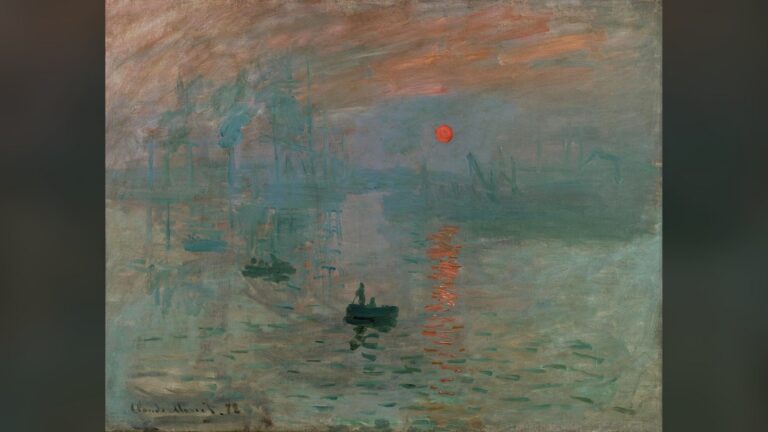
His chiaroscuro became a trademark. Artists who followed, Rembrandt in the Netherlands, Georges de La Tour in France, David Teniers and others across Europe, borrowed his dramatic contrasts and his interest in ordinary faces. Caravaggio’s technique in The Calling of Saint Matthew had a lasting influence on many European artists. The painting reflects Counter-Reformation ideals by making sacred themes understandable and accessible to ordinary people, not just scholars reading Latin. Even Pope Francis has described the painting as a personal reflection of sin, saying he saw himself in Matthew’s startled face. The father of modern religious art, some have called Caravaggio, though he would probably have bristled at the title. If you want to see how that break with tradition kept going, how Monet’s sunrise named Impressionism picks up the thread two centuries later.
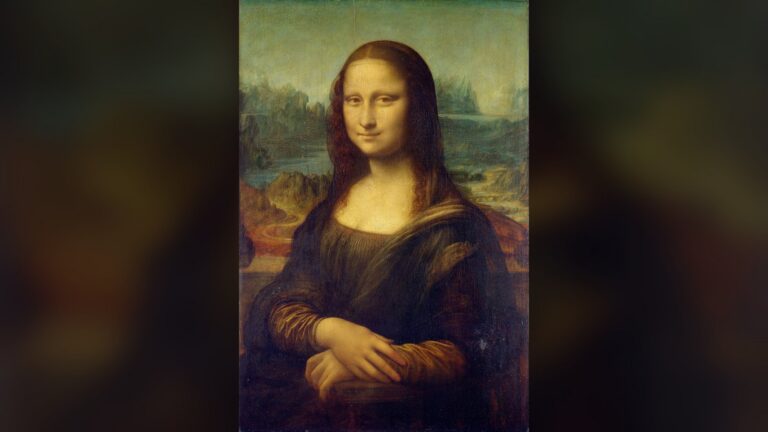
My own takeaway as someone who rides a tram to work: a sacred subject does not have to look polished to feel serious. These are men you might sit next to on public transport. That is the point. If you are curious why some images travel far beyond their original walls, my piece on why the Mona Lisa became famous looks at that question.
How to look at The Calling of Saint Matthew (even if you never get to Rome)
I spend longer in front of paintings than most visitors. Part of that comes from drawing. When I copy a section of a painting in my notebook, even badly, I notice things I missed while just looking. If you are new to looking this closely, my guide on how to appreciate art covers the basics I skip here. If galleries still leave you feeling lost, read feeling lost in galleries next.
Here is how I suggest reading this painting, even from a printed reproduction:
-
Stand back. See the dark room first. Notice where your eye goes. It will follow the beam of light to Matthew’s hand.
-
Trace the line. Follow Christ’s arm from right to left, then follow Peter’s body. See how they guide your gaze across the scene.
-
Check the hands. Christ’s hand pointing, Matthew’s finger pointing back, Peter’s palm. Hands that count money do not look up.
-
Check the feet. Christ’s feet and Peter’s feet are bare. The tax men wear boots. Clothes and shoes tell you who is who.
-
Find the figure who does not notice. At least one person at the table is completely oblivious. That raises a question worth sitting with.
For the copy sketch method, I print a reproduction no bigger than my hand. I shade the dark areas first with a soft pencil and leave the lit areas as bare paper. Then I mark the line of Jesus’s arm and the line of the light. I stop after ten minutes. Ten minutes of drawing taught me more about this painting than an hour of reading, because the composition is really three or four big shapes separated by darkness.
A warning: scale matters. The original is over three metres wide. Shadows that look grey on a screen were meant to swallow detail in a chapel. If the reproduction looks too bright, Caravaggio probably planned it darker.
This painting is, in the end, a story about being interrupted. A man sits at his table doing what he does every day, and something happened that changed everything. The cross he would eventually bear, the inspiration he would eventually write, the death he would eventually meet, all of it starts with this one moment of looking up. That is the power of it. You do not need to be in Rome. You do not need to be free of doubt. You just need to stand a little longer and let the light land where it will.
FAQ
Who painted The Calling of St Matthew? Caravaggio (Michelangelo Merisi da Caravaggio), working in Rome around 1599 to 1600 as a major church commission for the Contarelli Chapel.
Where can I see The Calling of St Matthew? In the Contarelli Chapel of San Luigi dei Francesi in Rome. It is part of the church itself, not a museum.
Which figure is Matthew in the painting? Most viewers read the bearded man pointing at himself as Matthew. Some argue for the young man looking down at the coins. The painting does not settle it.
What does the light mean? My hobbyist reading: it is the call itself arriving in a dark room, linking Christ’s gesture to Matthew’s reaction. The light is not just illumination. It is the whole meaning of the scene.
Do I need to know the Bible story to enjoy it? No. One sentence is enough: Jesus calls a tax collector to follow him. The rest, the artist shows you.