Why Is Monet’s Impression, Sunrise Called the Painting That Named Impressionism?
A critic’s insult turning into an entire art movement is the neatest story I know in painting, and it starts with one small canvas of a harbour at dawn.
Claude Monet Impression Rising Sun: What the Painting Is and Why It Matters
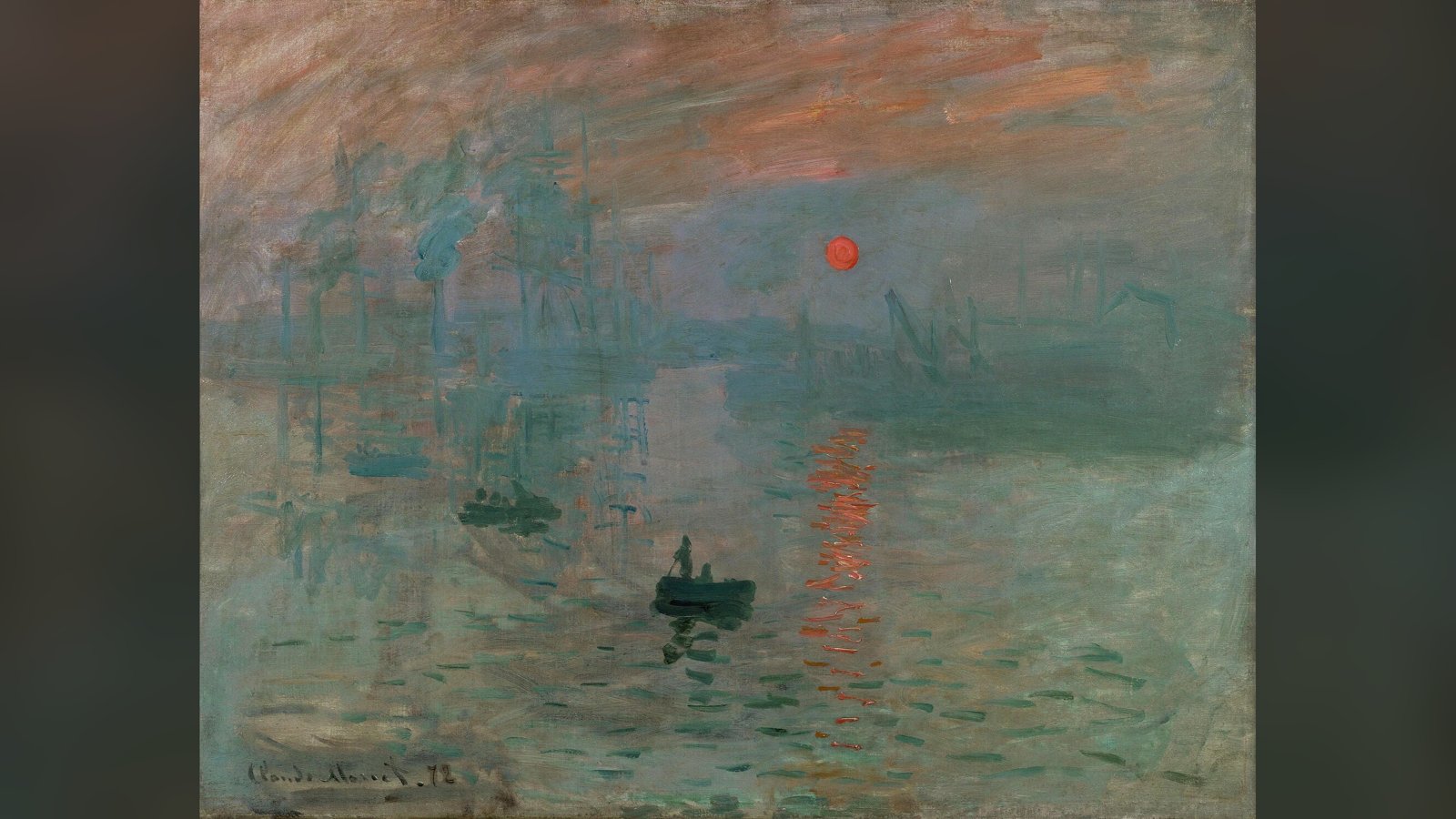
Claude Monet’s Impression Sunrise, the English rendering of Impression, soleil levant, is the November 1872 painting of Le Havre at sunrise that gave Impressionism its name and is often treated as the movement’s birth certificate. The scene shows the port of Le Havre in France at sunrise: an orange sun glowing through mist above dark water, small boats, and faint cranes. Monet titled it Impression, soleil levant because he felt it could not honestly be called a finished view.
It hangs today at the Musée Marmottan Monet in Paris. Impression Sunrise is smaller and quieter than its reputation, roughly 50 by 65 cm. If you enjoy museums and famous paintings but feel you know nothing about art, are visiting a gallery for the first time, or want to sketch from the old masters without getting lost in theory, this is a plain-language look at what Monet painted, how he made it, why it changed the way people see light, how it helped start Impressionism, what happened to the work afterward, and how to look at it with enough confidence to enjoy it. For the basic facts, the Wikipedia page for Impression, Sunrise is a fair starting point.
I am Dev, a tram driver in Adelaide who spends rest days in galleries with a notebook. I am a hobbyist, not an art historian, and I have only seen this artwork in books and on screen, never in Paris, London or New York. Even so, it changed how I look at light and made galleries feel less intimidating. The table below is a short summary of the key facts.
|
Detail |
Answer |
|---|---|
|
Title |
Impression Sunrise (Impression, soleil levant) |
|
Artist |
Claude Monet |
|
Date |
November 1872 |
|
Subject |
Port of Le Havre at dawn |
|
Museum |
Marmottan Museum, Paris |
The morning at Le Havre: what Claude Monet actually painted
Monet’s impression was made in one sitting at about 7:35 am, from his hotel room window at the Hôtel de l’Amirauté, looking across Le Havre’s outer harbour. The hazy scene is built from a low horizon, mist, still water, and a pale blue and grey sky. Two small rowing boats sit as dark silhouettes in the foreground, while steamships, masts and cranes dissolve behind them, with smoke from distant chimneys in the background.
In Impression Sunrise the rising sun is almost the only warm colour. Try a squint test: the sun’s brightness matches the sky’s, which is why the orange disc seems to flicker rather than sit still. Monet used thin washes across sky and water, then heavier touches for the sun and its broken reflection. He wanted to capture one fleeting moment of dawn light, not to create a postcard. If strong contrasts between light and shadow interest you more, this guide to dramatic light and shadow in painting shows a very different approach.
Stand back first and take in the misty mood, then step closer to see how rough the canvas is.
From sketch to Monet’s impression: how the painting was made
Monet called it an impression and a seascape because the sunrise over the harbour was a quick sensation, not a carefully drawn view. Loose brush strokes suggest rather than describe, conveying the harbour’s light and atmosphere. The canvas shows through in places, the background dissolves into mist, and masts become a few vertical lines. That emphasis on perception over realism was radical in the early 1870s, and Monet’s impression still looks bold. This style of painting is meant to capture a feeling, and in the 19th century the hotel room view gave him a perfect spot for that experiment.
Ask yourself what is missing. There is no outline, no story, no figures you could name. Yet if you still feel the cold, damp morning, the artist has done his job.
A practical exercise: do three matchbox-sized thumbnails in a notebook, one for tones, one for main shapes, one for the reflection in short broken strokes. It will not look like Monet. The point is discovering what he left out. If you have tried drawing an old-fashioned valentine face from Lisa’s teaching, you already know the thinking: decide what matters and leave the rest alone.
1874 and the birth of the impressionist movement
On April 15, 1874, Claude Monet and friends including Renoir, Pissarro, Degas, Sisley and Morisot opened the first Impressionist Exhibition in the photographer Nadar’s former studio in Paris, after repeated rejection by the official Salon. Impression, soleil levant was exhibited there from April 15 to May 15, 1874. These were the future impressionists, and for the impressionist movement it was the first big public test. The catalogue entry for the Claude Monet impression of the harbour read simply Impression, soleil levant. The audience was mostly puzzled or amused.
The critic Louis Leroy, writing in Le Charivari, seized the title. He mocked the artwork as less finished than wallpaper in its early stages and used the word impressionists as an insult, a reaction that helped produce the term Impressionists. The painting was discussed only five times in exhibition reviews. Most critics found Impression Sunrise unrecognizable. Yet the painters embraced the label, and the impressionists went on to hold eight shows together. The term Impressionism was first used by Leroy in that review, and it stuck. For more on the man himself, see the Louis Leroy entry on Wikipedia.
Why this painting and not another? The title gave Leroy a hook, it was an extreme case of the loose, unfinished style, and a small orange sun over a grey harbour is easy to remember. That exhibition and the title’s afterlife helped turn it into a famous painting. I treat the exact 1874 wording with caution, since much of it comes from later recollections, but the broad story holds: the show became a turning point in the history of art.
A long, strange journey: theft, recovery, and today
Purchased for 800 francs in May 1874 and sold for 800 francs that year before the collapse of its first buyer’s finances in 1878, the painting was then auctioned for 210 francs to collector Georges de Bellio, listed incorrectly as “Impression, Sunset.” His daughter gave the Marmottan a gift in 1940. During the war it spent time away from public view, waiting in the shadows before later recognition.
On 27 October 1985 it was stolen from the museum along with other works. It vanished for five years before police in France recovered it in December 1990. The Marmottan rehung it in 1991 and has since shown it as a centrepiece in exhibitions, including those marking the 150th anniversary of the 1874 exhibition. The rising sun often stands for hope after darkness, and here the painting’s own story mirrors that.
A painting’s fame is not only the picture but what happens around it. If you have read about why the Mona Lisa is famous, you know the pattern: art and events together create a household name.
How I look at Impression Sunrise today
I first saw this painting in a library book, with a print barely larger than a playing card. It looked rough, almost careless. Then one morning on an early tram shift in Adelaide I watched orange light hit wet asphalt after rain, and the colour lasted maybe thirty seconds. I thought of Monet trying to capture exactly that, and Impression Sunrise made sense.
A rising sun is never just a circle of light. It symbolizes new beginnings in many cultures, and in literature it is a common metaphor for change. Monet probably did not think about any of that, but the image taps into it, which is part of why a small orange disc on a grey canvas still stops people in a room.
Here is a routine for a reproduction, a book or a screen. Take in the mood from a distance. Squint to see light and dark. Find the one warm colour. Trace the boats. Then spend five minutes with a pencil placing sun, boats and horizon on scrap paper. You will discover what Monet left out.
If you have ever felt lost in a gallery, try this with any of the impressionists’ landscapes. Treat each one as a quick impression of a scene rather than a finished picture. It is less intimidating that way. If you want to keep wandering, I have written about the most famous paintings of famous painters as the next place to look. For a wider guide, read how to appreciate the arts when you feel lost.
FAQ
Who named the impressionist movement?
The critic Louis Leroy popularised the word in a mocking review of the 1874 exhibition, taking his cue from Claude Monet’s title. The impressionists later adopted it.
Where is Impression Sunrise today?
At the Musée Marmottan Monet in Paris. I have only seen reproductions, so for how it looks in person I trust people who have stood in front of it.
What does Impression Sunrise show?
A depiction of Le Havre’s harbour at sunrise: morning mist, small boats in the foreground, faint ships and cranes behind, and an orange sun reflected in the water.
Is Impression Rising Sun another name for the painting?
Yes, it is a looser English rendering of Impression, soleil levant, which literally means rising sun.
Was it really called an unfinished painting?
That was Leroy’s comment. The impressionists saw the loose handling as deliberate, a way of catching a fleeting effect of light, not an excuse for sloppiness.
Can a beginner learn anything from copying Impression Sunrise?
Yes. A quick tonal sketch teaches you to see big shapes and values before detail, which helps any drawing.